
GitLab and The Importance of Self-Hosting Critical Applications
“Cloud-first” continues to be the mantra of many software platforms on the market today. But, what about the self-hosted capabilities? Well – today we’re here to talk to you about why GitLab’s continued commitment to a self-hosted (self-managed) option is such a big deal, especially for teams with serious security, compliance, and sovereignty requirements.
What does self-hosting mean (and what it doesn’t)?
Self-hosting means you run the application on infrastructure you control: your own data center, private cloud, sovereign cloud, isolated enclave, or even an air-gapped environment. You choose where the data lives, how it’s backed up, what network paths are allowed, how identity is integrated, and when upgrades happen. In other words, you control the operational boundary.
This isn’t nostalgia for “servers in a closet.” Self-hosting is a deployment model that reduces risk in environments where outsourcing the control plane to a vendor-operated SaaS is either impossible or irresponsible.
Why does self-hosting still matter?
There are several recurring drivers behind self-hosting:
- Data sovereignty and residency: Some organizations must guarantee that source code, logs, and artifacts remain in specific jurisdictions or enclaves.
- Security architecture: Restricted-egress, zero-trust segmentation, and offline/air-gapped workflows are difficult (or impossible) to implement in a pure SaaS model.
- Change control and uptime: Regulated environments often require formal maintenance windows, staged rollouts, and deep observability.
- Vendor risk: Self-hosting provides leverage against pricing shocks, deprecations, or sudden platform direction changes.
Atlassian’s Data Center pivot: a clear market signal
Late last year, Atlassian made a decisive move by publishing a Data Center end-of-life timeline for several products. The company states that Data Center support will wind down in phases beginning March 30, 2026, with end of life on March 28, 2029, and that new Data Center subscriptions for new customers end March 30, 2026. This is the direction many vendors are taking: a tightening path toward SaaS-only (with limited exceptions).
Regardless of whether you agree with the strategy, it changes the calculus for customers who need to control where and how critical developer tooling runs.
GitLab’s differentiator: self-managed stays first-class
GitLab, by contrast, continues to treat self-hosting as a first-class citizen. In GitLab’s own documentation, GitLab Self-Managed is explicitly: “Install, administer, and maintain your own GitLab instance.” And GitLab’s administration docs clearly distinguish SaaS from self-managed operation: if you run a self-managed instance, you (not the vendor) control the administrative plane.
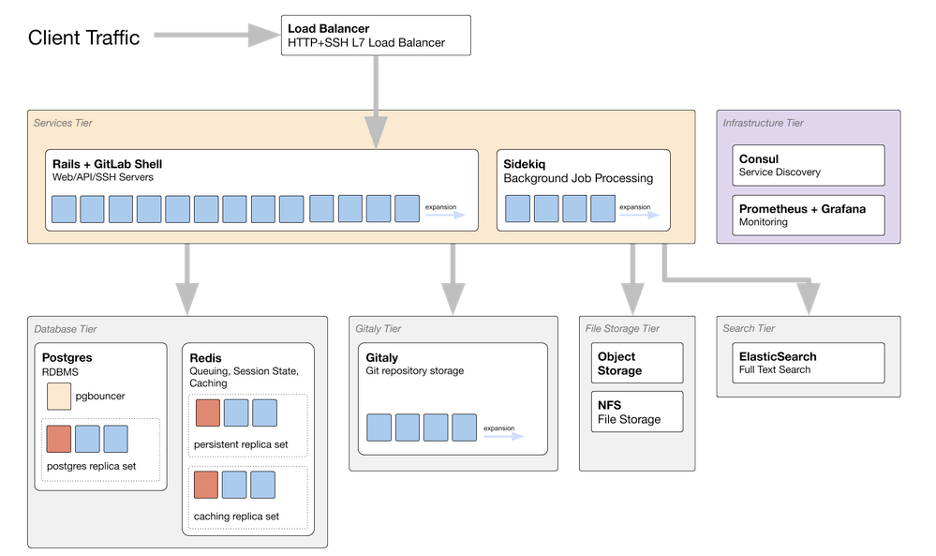
That’s not a minor packaging choice. It means GitLab can fit into high-control environments without forcing a compromise on governance, network topology, or operational policy. Even its architecture, as per the diagram below, is designed to scale to meet your organization’s most demanding needs.
Why does the Federal Government care about self-hosting?
For U.S. federal agencies, these issues aren’t academic. FedRAMP is a government-wide program established in law, that provides a standardized approach to security assessment and authorization for cloud services used by agencies. Agencies also align security programs to NIST control frameworks and baselines (for example, NIST SP 800-53B baselines for federal systems).
In practice, many federal use cases involve restricted networks, sensitive development pipelines, stringent auditing, and mission-driven continuity requirements. A platform that can be deployed inside those constraints—without waiting on vendor roadmap decisions—is operationally and strategically valuable.
Cloud is great—until it’s not an option. GitLab’s self-hosted commitment ensures that teams, including the federal government and its partners, can adopt modern DevSecOps workflows while still meeting the reality of sovereignty, compliance, and control.
Interested in learning more about GitLab and its on premise solutions? Contact us today!