
GitOps: More Than Just a Buzzword
The IT word loves buzzwords. The number of times we hear “DevOps” and “Agile” in any given day would surprise most. A new buzzword which we’ve seen appear more often in presentations is “GitOps.” So, what exactly is GitOps, and how does it relate to DevOps? And how do you use GitLab for GitOps? We’ll explore that here, and more!
What Is GitOps and How Does It Relate to DevOps?
GitOps is a set of practices bringing principles of DevOps (e.g., version control, automation, collaboration, etc.) to infrastructure and operations, helping you to manage and version control your Infrastructure as Code (IaC). Simply put, GitOps is the ability for your team to provide DevOps best practices to the code, scripts, and configurations you make to tools supporting your developers (think of Terraform).
GitLab and GitOps
GitLab integrates GitOps workflows seamlessly by combining version control, CI/CD pipelines, and automation in a single platform. Below are a handful of advantages and capabilities that GitLab has to offer for GitOps:
- Single Source of Truth: GitLab repositories store declarative configurations for infrastructure and applications (e.g., Kubernetes manifests, helm charts, Terraform scripts). All configurations are tracked using GitLab’s version control system.
- IaC Capabilities: GitLab supports storing and managing IaC files, such as Terraform, Kubernetes, YAML, and Ansible Playbooks. Changes are reviewed and approved using the Merge Requests process.
- CI/CD Pipelines for GitOps: CI/CD automates applying changes to the target infrastructure or application.
- Tight Integration with Terraform: GitLab has built-in integration with Terraform for environment provisioning.
- Monitoring & Observability: GitLab provides monitoring features, such as built-in metrics and reporting, to track deployments and detect issues. GitLab also supports integrations with Prometheus and Grafana to enhance operational visibility.
Why Is GitOps Important?
So why does this buzzword matter? GitOps may not mean much, but it’s been around for years. 20 years ago, Configuration Managers writing Maven build scripts and YAML files (yes, Maven and YAML are both over 20 years old!) version controlled their scripts with Subversion. In fact, many consider Configuration Managers to be the precursor to the modern DevOps engineer, but that’s a story for another time.
GitOps, and what GitLab has to offer, is an evolution of this revolutionary idea – version controlling your IaC to ensure that you can revert, store, and recall versions of scripts should a rollback be needed. GitOps is important because it brings structure, consistency, and efficiency to managing your infrastructure applications (illustrated in the diagram below).
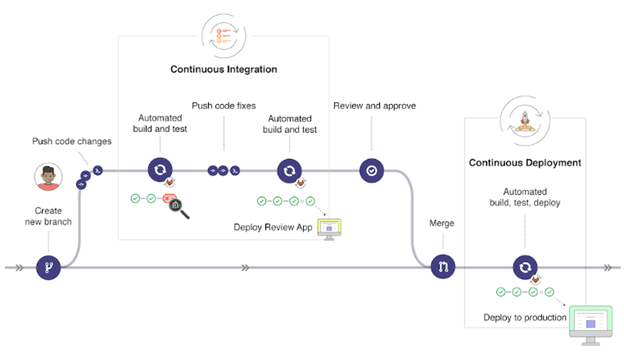
By using GitLab, you have the ability to version control, release, update, and monitor your GitOps functions seamlessly.
Interested in learning more about GitLab and GitOps? Contact us today!